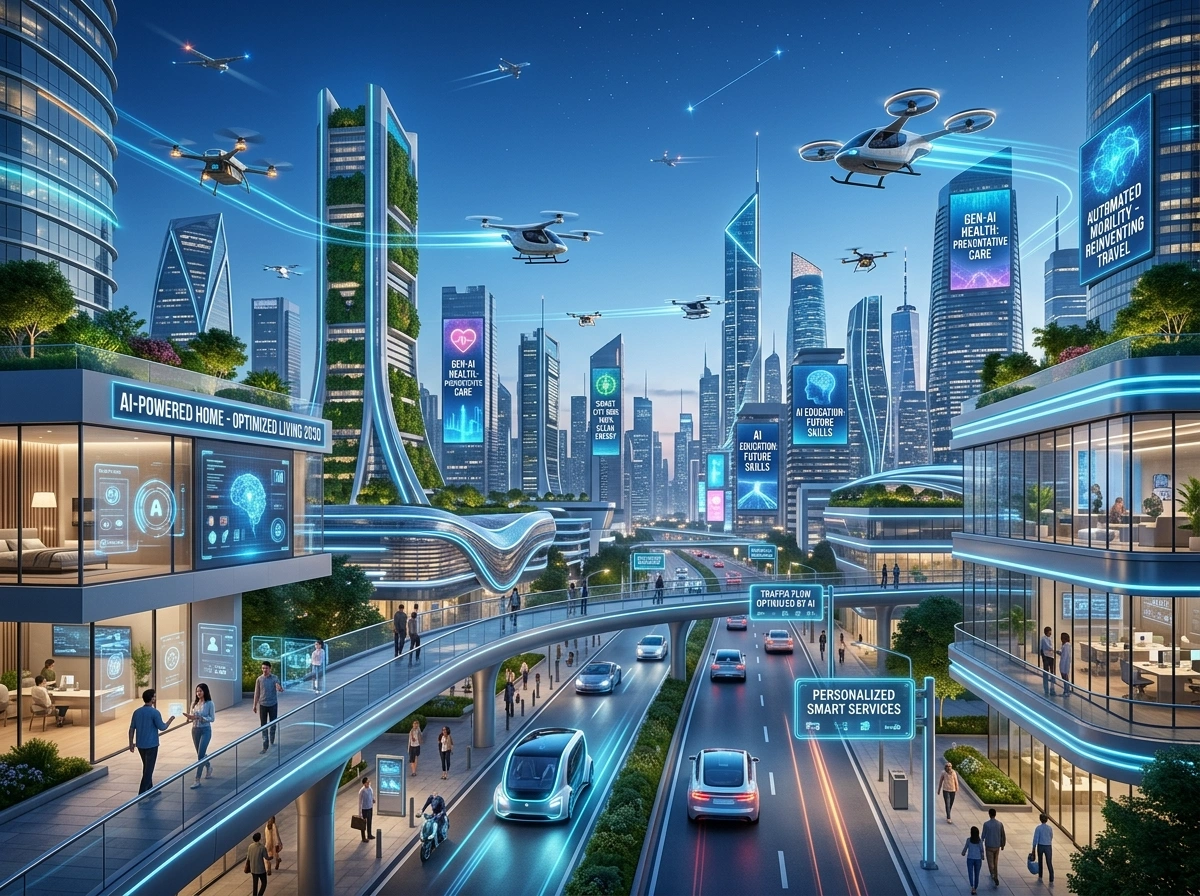
Artificial intelligence has moved from science fiction into the fabric of daily American life. It recommends what you watch, filters your inbox, and helps your doctor spot problems sooner. Yet what we see now is only the opening act. By 2030, AI will touch nearly every routine you have, from the moment you wake up to the way you commute, work, and care for your family.
At tech hence, we track these shifts closely. We believe the next five years will bring changes that feel less like upgrades and more like a reinvention of ordinary living. Here’s why, and where the biggest transformations will land.
The Pace of Change Is Accelerating
Technology adoption in the United States moves fast, and AI is no exception. High-speed internet, powerful smartphones, and cloud computing have laid the groundwork. Now, generative AI tools are reaching millions of people who never wrote a line of code.
What used to take a research lab years to build can now be spun up in weeks. That speed matters. When barriers drop and costs fall, innovation spreads from coastal tech hubs to small towns in the Midwest and rural communities across the South. AI won’t stay a luxury for early adopters. It will become a standard part of everyday tools that people across every region depend on.
AI in Healthcare: Smarter, Faster, More Personal
Healthcare may see the most life-changing effects of all. By 2030, AI systems will help physicians diagnose conditions earlier and with greater accuracy. Imaging tools already flag tumors human eyes might miss. Expect that capability to sharpen and expand.
Personalized Treatment Plans
AI can analyze your genetics, lifestyle, and medical history to suggest treatments tailored to you rather than the average patient. This shift toward personalized medicine could improve outcomes for chronic conditions like diabetes and heart disease, which affect millions of Americans.
Better Access in Underserved Areas
Rural and low-income communities often struggle with doctor shortages. AI-powered telehealth tools can bridge that gap, offering symptom checks, mental health support, and follow-up care without long drives to a clinic. For a country with such varied geography, that reach is a real breakthrough.
Of course, healthcare is one of the most regulated industries in America. Any AI tool will need to meet strict federal and state standards for privacy and safety. Responsible developers will build compliance into their systems from day one.
Smart Homes That Truly Understand You
Smart speakers and connected thermostats gave us a taste of automated living. By 2030, your home will do far more than respond to voice commands. It will anticipate your needs.
Picture a home that learns your schedule, adjusts lighting and temperature to match your mood, and reminds you to take medication. AI will coordinate appliances, security cameras, and energy use to save money and reduce waste. For families juggling busy lives, that kind of quiet efficiency adds up.
Energy management is a big deal here. With electricity costs varying widely from state to state, AI systems that optimize power use could ease household budgets. Homes may even sell surplus solar energy back to the grid automatically, guided by smart algorithms that know the best time to buy and sell.
Transportation Reimagined
Getting around America is about to change in ways that go beyond self-driving cars, though those matter too. Autonomous vehicles continue to improve, and by 2030 we expect wider deployment of driverless ride-sharing in major cities.
But the bigger story is intelligence woven into the entire transportation system. AI will manage traffic flow in real time, cutting congestion in places like Los Angeles and Atlanta. Delivery networks will route packages more efficiently, lowering costs for businesses and shoppers alike.
Public transit could get smarter too, adjusting routes and schedules based on actual demand. For a nation that spends so many hours behind the wheel, even modest gains in efficiency translate into hours reclaimed and emissions reduced.
Education Tailored to Every Learner
The classroom of 2030 will look different from the one many of us grew up in. AI tutors can adapt to each student’s pace, offering extra help where it’s needed and moving ahead when a student is ready. This kind of personalized learning has long been a goal for educators, and AI finally makes it scalable.
Support for Teachers, Not a Replacement
Some worry AI will push teachers aside. We see it differently. AI handles repetitive tasks like grading and lesson prep, freeing teachers to focus on mentoring and connection. Great teaching has always been about human relationships, and technology should protect that, not erase it.
Closing the Opportunity Gap
Students in well-funded districts have long enjoyed advantages over those in struggling schools. Affordable AI learning tools could help level that field, giving every child access to quality instruction regardless of zip code. In a country as diverse as ours, that promise is worth pursuing.
Work and Productivity: A New Partnership
The workplace is where many Americans first felt AI’s impact, and the transformation is far from over. By 2030, AI assistants will handle routine tasks across nearly every profession. Writers get drafting help, accountants automate data entry, and marketers analyze customer behavior in seconds.
This raises understandable concerns about jobs. History suggests technology tends to reshape work rather than eliminate it wholesale. New roles will emerge, many centered on managing, training, and improving AI systems. The workers who thrive will be those who learn to collaborate with these tools rather than compete against them.
Small businesses stand to gain a lot. AI levels the playing field, giving a family-owned shop in Ohio access to the same marketing insights and customer service tools that once belonged only to large corporations. That’s a meaningful shift for the backbone of the American economy.
Balancing Progress With Responsibility
Excitement about AI should come with clear eyes. Privacy, security, and fairness matter deeply. Americans want to know their data is protected and that AI treats people equitably. The complex web of federal and state regulations will shape how these tools roll out, and that’s a good thing.
Trust will decide how fast and how far AI spreads. Companies that build transparent, compliant, and genuinely helpful tools will earn public confidence. Those that cut corners will lose it. We believe the winners of this era will be the ones who put people first.
The Road to 2030
None of this happens overnight. The transformation will arrive in waves, some barely noticed until we look back and realize how much has changed. Just as smartphones quietly rewired daily life within a decade, AI will weave itself into our routines until living without it feels strange.
The America of 2030 won’t be a robot-run dystopia or a flawless utopia. It will be a place where AI quietly handles the tedious parts of life, giving people more time for what matters. Better health, smarter homes, easier commutes, richer learning, and more meaningful work all sit within reach.
That’s why we remain optimistic. The tools are here, the momentum is building, and the benefits are real. The next five years will be a defining chapter, and we’re excited to help people navigate it. The future isn’t something that happens to us. It’s something we build together, one smart decision at a time.