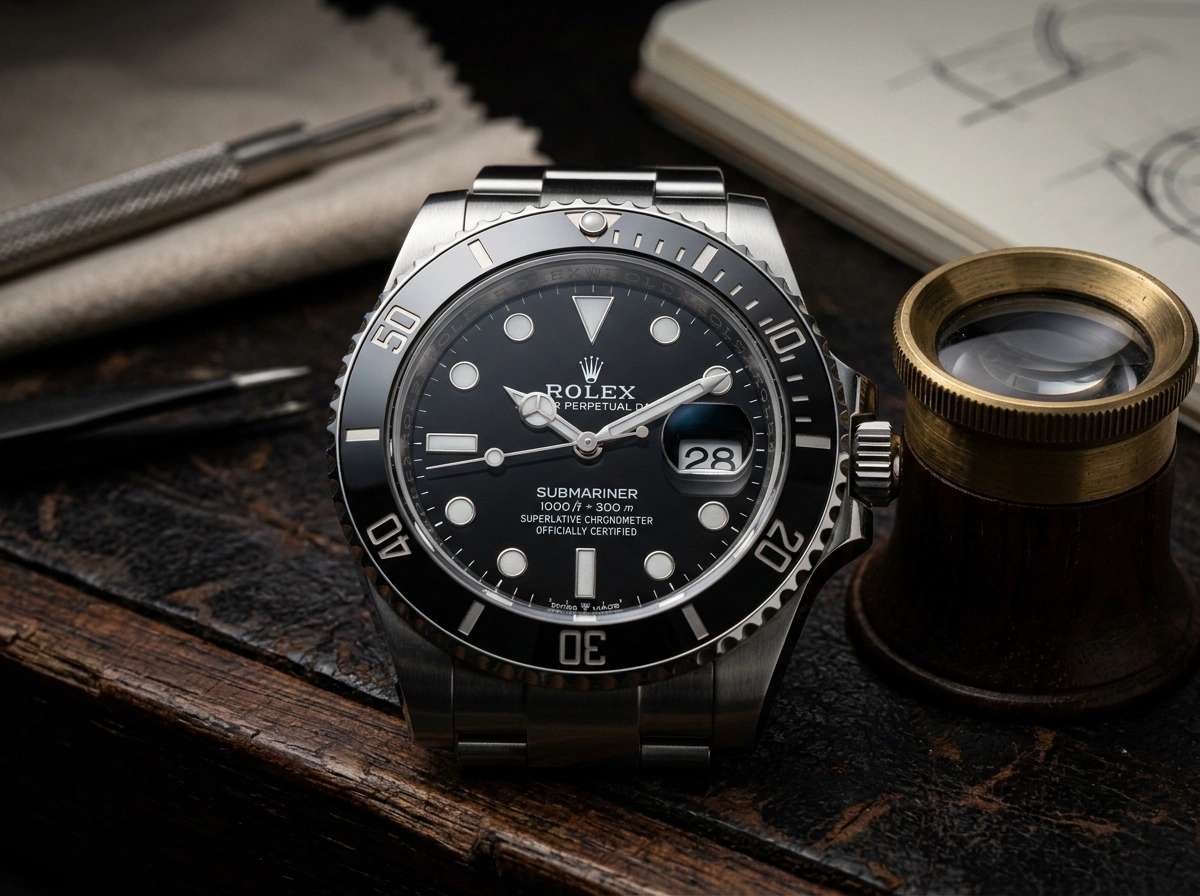
A genuine Rolex is more than a watch. It’s a precision instrument built to exacting standards, which is exactly why counterfeiters work so hard to copy it. The problem? Fakes are getting better every year, and the average buyer can struggle to tell the difference at a glance.
The good news is that even the best replicas leave clues. Once you know where to look, those clues become hard to miss. This guide walks you through nine telltale signs that separate an authentic Rolex from a convincing imitation, so you can shop with confidence and protect your money.
1. Check the Weight in Your Hand
One of the fastest first tests is simply picking the watch up. Authentic Rolex models use high-grade 904L stainless steel, solid gold, or platinum, all of which give the watch a substantial, dense feel.
Many counterfeits cut costs with lighter, hollow metals. If a “Rolex” feels surprisingly light or flimsy, that’s an instant warning sign. While weight alone won’t confirm authenticity, a watch that feels cheap almost always is.
What to do: Compare the weight against a known genuine model if possible. Hollow links and a lightweight clasp are common giveaways on fakes.
2. Examine the Cyclops Lens Magnification
The cyclops is the small magnifying bubble over the date window. On a real Rolex, it magnifies the date roughly 2.5 times, making the number fill the lens and appear large and crisp.
Counterfeit cyclops lenses often magnify weakly or not at all, leaving the date looking small and distant. The date should also sit perfectly centered under the bubble.
What to do: Look straight down at the date. If the number looks tiny or off-center, you’re likely holding a fake.
3. Listen to and Watch the Movement
This is one of the most reliable tells. Rolex uses automatic mechanical movements with a smooth, sweeping second hand. The motion looks almost continuous rather than ticking.
Cheaper fakes use quartz movements that produce a visible tick-tick-tick once per second. Even higher-quality replicas with automatic movements rarely match the seamless glide of a genuine Rolex.
What to do: Watch the second hand for ten seconds. A jerky, one-tick-per-second motion strongly suggests a counterfeit. Many seasoned collectors study the differences between authentic pieces and a fake rolex to train their eye on movement behavior.
4. Inspect the Serial and Model Numbers
Every authentic Rolex carries a serial number and a model (reference) number. On modern models, the serial number is laser-etched between the lugs on the case, and there’s a tiny “Rolex” crown logo etched into the crystal at the six o’clock position, visible only under magnification.
Fakes often have shallow, sandy, or poorly aligned engravings. Some replicas skip the crystal etching entirely or render it as a clumsy dot.
What to do: Use a loupe to check the engraving quality. Genuine Rolex numbers are razor-sharp, smooth, and perfectly straight.
5. Study the Dial and Text Quality
Rolex holds its dial printing to an extraordinary standard. Text is sharp, evenly spaced, and flawless. There are no smudges, no bleeding ink, and no crooked letters.
On counterfeits, look closely at the lettering. Blurry print, uneven spacing, misaligned text, or slightly wrong fonts are all common flaws. Spelling mistakes, though rare now, are an immediate disqualifier.
What to do: Magnify the dial text. The Rolex name, “Oyster Perpetual,” and any model designation should be perfectly crisp and clean.
6. Feel the Finishing and Craftsmanship
Rolex finishing is a benchmark in the industry. Edges are smooth, brushing is uniform, and polished surfaces are mirror-clean. Every component fits together with no gaps, no sharp burrs, and no rough spots.
Counterfeits frequently reveal themselves through poor finishing. Run your fingertip along the case edges and bracelet. Sharp edges, uneven brushing, visible glue, or rattling parts point to a fake.
What to do: Inspect the bracelet links and clasp closely. A genuine clasp closes with a precise, satisfying click and shows no rough machining.
7. Check the Caseback
With very few exceptions, authentic Rolex watches have a smooth, plain caseback with no engravings, no clear windows, and no decorative text. Rolex does not display its movement through a transparent caseback on standard models.
A clear caseback showing the movement, or one engraved with logos and patterns, is a classic counterfeit trait. Some fakes add these “features” to look impressive, but they break Rolex’s actual design rules.
What to do: If you see a see-through caseback on a model that shouldn’t have one, treat it as a major red flag.
8. Examine the Crown and Winding Feel
The winding crown on a real Rolex carries a precisely engraved crown logo and screws down smoothly to seal the case. The threading is fine, even, and effortless.
Fakes often have a crudely shaped crown logo and gritty, loose, or stiff threading. The crown may not seat properly or may feel cheap when turned.
What to do: Gently unscrew and rescrew the crown. Smooth, confident threading is a sign of authentic engineering.
9. Scrutinize the Seller and the Price
Sometimes the biggest warning sign isn’t on the watch at all. It’s the deal. A genuine Rolex holds significant value, so a “brand new” model at a fraction of retail price is almost always a counterfeit.
Watch for sellers who avoid showing serial numbers, refuse original paperwork, push you to buy quickly, or only accept untraceable payments. Authentic dealers provide the box, papers, and a verifiable purchase history.
What to do: Buy from authorized dealers or reputable resellers. Ask for the original documentation and verify the serial number before committing.
Final Thoughts
Spotting a fake Rolex comes down to attention to detail. Genuine pieces reveal their quality through weight, a sweeping movement, flawless dial printing, sharp engravings, and immaculate finishing. Counterfeits cut corners, and those shortcuts always leave evidence.
Before you buy, run through this nine-point checklist: feel the weight, test the cyclops, watch the movement, inspect the serial numbers, study the dial, check the finishing, examine the caseback, test the crown, and vet the seller. Any single failure is reason for caution, and several together confirm a fake.
When in doubt, slow down and seek a professional appraisal. A trusted jeweler or authorized Rolex dealer can confirm authenticity in minutes. Taking that extra step protects both your investment and your peace of mind.